
Romi’s C 1100H heavy-duty flatbed lathe optimizes power, torque, accuracy and stability making it ideal for machining large parts. It is built with a Romi-made monoblock cast iron bed that absorbs machining efforts and vibration, making it highly rigid, stable and accurate.
The C 1100H is equipped with a cast iron headstock, also manufactured by Romi, that features a spindle with Timken bearings. It has a coolant and lubricating system equipped with a heat exchanger and sensors for temperature, pressure, flow and filter. It is powered by a high torque, continuously variable speed AC motor.
Romi C 1100H Heavy Duty CNC Lathe is Ideal for Machining Large PartsERLANGER, KY (October 3, 2022) – Romi’s C 1100H heavy-duty flatbed lathe optimizes power, torque, accuracy, and stability making it ideal for machining large parts. It is built with a Romi-made monoblock cast iron bed that absorbs machining efforts and vibration, making it highly rigid, stable, and accurate.
The C 1100H is equipped with a cast iron headstock, also manufactured by Romi, that features a spindle with Timken bearings. It has a coolant and lubricating system equipped with a heat exchanger and sensors for temperature, pressure, flow, and filter. It is powered by a high torque, continuously variable speed AC motor.
Source: Today’s Machining World
VMC with Features to Improve Precision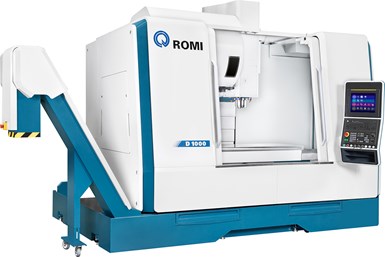
Romi’s New Generation D 1000 vertical machining center was designed and built based on extensive customer research, and has numerous features that enhance the machine’s rigidity and precision, the company reported.
“Like all Romi machine tools, it is built with Romi-made monoblock cast iron beds that absorb vibration and allow consistent production of highly precise parts. It features thermal compensation with sensors to help maintain stable, dimensional results in real time, even during long working periods when the machine temperature increases,” said a company spokesperson. The Romi VMC is also equipped with a low maintenance, 40 BIG-PLUS taper direct drive motor that is designed to improve stiffness and accuracy and allow increased depth of cut.
Heavy-Duty Lathe for Machining Large Steel Parts
The C 1800H heavy-duty CNC Lathe from Romi is designed for machining very large steel parts and components.
Weighing in at 97,000 lbs., the lathe features a distance between centers from 157″ to 394″, a 47″ swing over cross slide and a max. weight capacity between centers of 66,100 lbs. at 50 RPM. The bed width and height are 55″ and 30″.
The 10 Latest Machine Tools & Equipment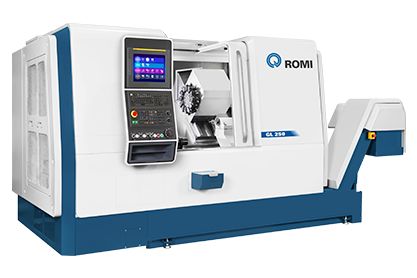
Horizontal Turning Center
The New Generation Romi GL 250 horizontal turning center from Romi Machine Tools comes equipped with thermal compensation with sensors to maintain stable, dimensional results, even during long working periods. The sensors provides accurate, real time compensation as opposed to compensation based on pre-defined algorithms. The result is more accurate machining over extended periods of time when the machine temperature increases.
Source: NED – New Equipment Digest
New Generation Turning Center with Sub-Spindle Ideal for Turning, Milling and Drilling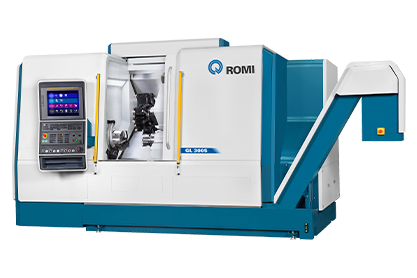
Romi’s New Generation GL 300S horizontal turning center is equipped with a sub-spindle and a Y-axis for off-center milling.
It has a maximum cutting diameter of 11.8″ (300 mm), Z-travel of 23.6″ (600 mm), and is designed for turning, milling, and drilling operations in high production environments. The GL300 S features high power torque and feed force and is built with a robust monoblock base for ultimate rigidity and precision. The machine weighs in at 11,464 lbs. (5200 kg).
Source: MAN – Modern Applications News
Romi GL 300S Turning Center with Sub-SpindleThe GL 300S comes equipped with thermal compensation with sensors to maintain stable, dimensional results even during long working periods.
Romi’s New Generation GL 300S horizontal turning center is equipped with a sub-spindle and a Y-axis for off-center milling. It has a maximum cutting diameter of 11.8″ (300 mm), Z-travel of 23.6″ (600 mm), and is designed for turning, milling, and drilling operations in high production environments. The GL300 S features high power torque and feed force and is built with a robust “Romi-made” monoblock base for ultimate rigidity and precision. The machine weighs in at 11,464 lbs. (5200 kg).
Romi’s GL 300S Turning Center With Sub-Spindle Is Ideal For Turning, Milling And DrillingThe New Generation GL 300S horizontal is equipped with a sub-spindle and a Y-axis for off-center milling and is designed for high production environments.
Romi’s New Generation GL 300S horizontal turning center is equipped with a sub-spindle and a Y-axis for off-center milling. It has a maximum cutting diameter of 11.8″ (300 mm), Z-travel of 23.6″ (600 mm), and is designed for turning, milling, and drilling operations in high production environments. The GL300 S features high power torque and feed force and is built with a robust “Romi-made” monoblock base for ultimate rigidity and precision. The machine weighs in at 11,464 lbs. (5200 kg).
Design Brings ROMI VMC Range of FeaturesD 1000 VMC Romi’s machine tools all start with a monoblock cast-iron bed, which provides a stable foundation and absorbs vibrations. Its D Series New Generation line of vertical machining centers (VMCs) is a good �it for machining molds and tooling. They are available in versions with maximum spindle speeds of
10,000 rpm and 15,000 rpm.
What’s new? The design of Romi’s new D 1000 VMC. It has a range of new features, including roller guides that increase precision and rigidity, a direct-drive
motor and a Fanuc 0i-MF i-HMI CNC control.
Source: Plastic Machinery & Manufacturing
Hybrid Manufacturing Turns Design Inside Out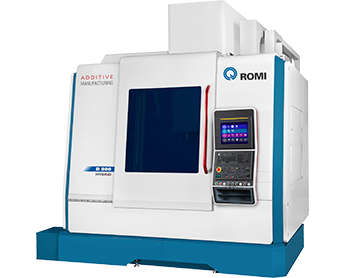
Hybrid systems combine traditional subtractive processes with additional processes, including laser metal deposition for additive manufacturing and friction stir welding, enabling manufacturers to design products from the inside-out.
Traditional manufacturing starts with a solid block of metal. Manufacturers think about how to mill, turn, grind and polish the part, move the part to the next manufacturing step, create subassemblies and bring parts together. Each activity occurs in distinct processing areas. Hybrid manufacturing disrupts that workflow.