
Romi has introduced the new Generation GL series 2-axis horizontal turning centers. The new machines are available in four models with maximum cutting diameters ranging from 11″ (282mm) to 19.3″ (490mm) and Z travel ranging from 23.6″ (600mm) to 47.2″ (1,200mm). Designed for medium to high production environments, the GL Series features notably high power, torque, and feed force, in addition to Romi’s trademark rigidity and precision attributed to the robust Romi-made monoblock base.
Models include the GL250, GL300, GL350, and GL450. Each is constructed with durable roller ways on all axis to produce high rigidity. A built-in spindle motor with a chiller incorporated and direct-drive servomotors results in high response speed, accuracy, less vibration, and lower maintenance requirements. Chilling the motor increases life expectancy and produces less thermal expansion.
The all new GL Series come standard with active thermal compensation to maintain consistent accuracy even as the machine temperature increases over the course of extended use. The tailstock is programmable and servo driven. Position, speed, and force are determined directly via the Fanuc controller that reduces setup time.
Each model comes with a 12-station turret with a choice of fixed tools with a Romi disk, driven tools with a VDI or BMT disk, driven tools with Y-axis, or dual spindle with driven tools and Y-axis.
The CNC control features a Fanuc Oi-TF with 15″ LCD touchscreen and Fanuc 32iB with 19″ LCD touchscreen for dual spindle version machines and is the newest generation of Fanuc’s Series iHMI. It is designed to produce faster, more accurate performance for turning applications with separate areas on the main screen for planning, machining, improvements, and utilities. Functions are accessible with just two clicks. It comes standard with an ethernet interface, as well as a compact flash card and USB ports.
Romi’s GL Series turning centers are all produced in Romi’s state-of-the-art facilities that maintain various safety and quality certifications including ISO 9001, ISO 14001, IATF 16949, and CE.
More details on Romi’s new line of GL Series turning centers can be found on Romi’s newly designed website.
Source: Today’s Motor Vehicles
Learn How to Increase Your Machining ProductivityWhen thinking about the evolution of conventional machining processes, previously supported only by mechanical lathes, milling machines or drills, we now have CNC lathes, turning centers and modern machining centers. These tools allow the complete machining of parts and even in a single fixation, such as can be performed on the ROMI DCM 620-5X Vertical Machining Center.
Whatever the size of your business, boosting productivity in machining is key to maintaining your competitiveness. In addition to the technological transformation provided by the modernizing of the industrial park, it is possible to obtain significant results by adopting good practices, while also focusing on people and processes. Here are some tips that will help you design more productive machining processes for your business:
1. Review Existing Workflow
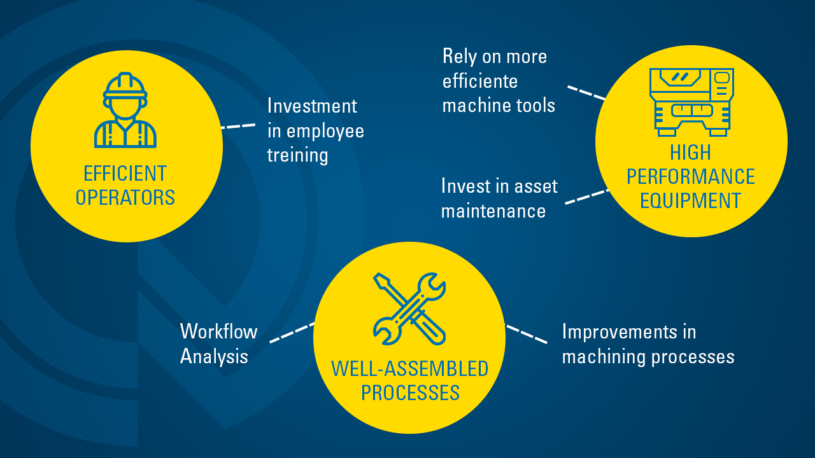
A good way to increase machining productivity is to identify workflow points that need attention. For this, it is necessary to visually map all the steps necessary for the manufacture of your products, understanding the inputs and outputs of each process, the procedures, resources needed, responsibilities, execution time and metrics.
Consider creating detailed flows for monitoring each process. Thus, it will be easier to identify areas with potential improvements, failures, delays, bottlenecks, or capacity problems, and make it possible to implement solutions and improvements.
2. Invest in Employee Training
The manufacturing industry including machine tools and cutting tools is constantly evolving. We are creating and implementing new technologies that make equipment more robust and more productive. Given this scenario, it is common for employees to require development and improvement of different skills needed to perform certain tasks.
Therefore, it is important to have an ongoing training program to ensure that your employees are taking full advantage of the capabilities of the machine tools and their peripherals. When properly trained, employees are more motivated and work more optimally, always seeking to deliver better results.
3. Study Improvements to Machining Processes
To meet the expectations and requirements of a customer of machined items, the development of an adequate, productive, and economical manufacturing process is indispensable. Each item to be manufactured has particularities that make its production process unique, either due to its constructive complexity, material, or finish.
Detailed machining studies, considering all aspects of the part to be developed – and here we talk about items such as parameters, tools and cutting conditions – allow us to analyze the process variables and seek appropriate solutions to obtain the best results. We also emphasize that in a machining process, just like any other process, we must seek continuous improvement, while introducing new technologies or possibilities.
4. Count on Smarter Machine Tools
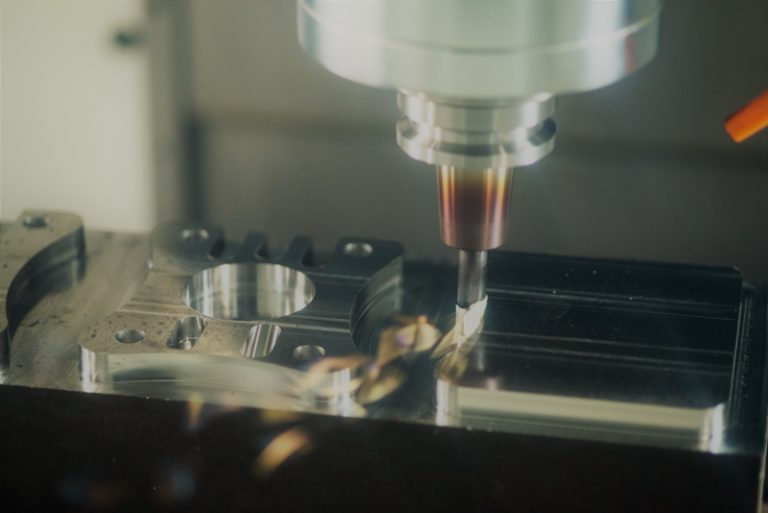
The evolution of machine tools, specifically in the area of computerization, digital controls, equipment and product development systems, and production controls, greatly impacts our ability to make machining more efficient and flexible. These “smart” features act as true operations centers.
Relying on CNC lathes, machining centers, turning centers and other tools with a high level of robustness and precision, is essential to guarantee more machining productivity. Given this scenario, today it is possible to produce much more, even in the face of complex production needs, while reducing costs and increasing the precision and quality of production.
The integration capability of machine tools is also contributing to the creation of much smarter and automated machining processes. An example is the Romi D Series Vertical Machining Center. All Romi D Series have a thermal compensation system, designed to reduce the effects of temperature oscillation on the dimensional aspects of machined parts.
By collecting the temperature data from sensors positioned in strategic locations, the CNC corrects the actual position of each axis, making the position of the tool follow accurate precision and enabling stable dimensional results even over long periods of work.
5. Invest in Asset Maintenance
Good maintenance management has a considerable impact on the costs associated with machine downtime, as well as on the time and budget invested in corrections. For this, it is essential to conduct routine maintenance of assets, which is appropriate for the company’s production schedule. The schedule should include routine inspections, and scheduling of preventive maintenance. New equipment can boost productivity, but it is also necessary to ensure its longevity and its correct functioning.
CNC teach lathes operate manually or automatically
Romi’s new generation of GL two-axis horizontal turning centers use built-in cooling technology and the latest CNC software to ensure increased accuracy and longer tool life.

Romi’s New Generation GL Series of two-axis horizontal turning centers are available in four models with maximum cutting diameters ranging from 11” (282 mm) to 19.3” (490 mm) and Z travel ranging from 23.6” (600 mm) to 47.2” (1,200 mm). Designed for medium- to high-production environments, the GL Series features high power, torque and feed force in addition to the “Romi-made” monoblock base’s rigidity and precision.
Models include the GL250, GL300, GL350 and GL450. The durable roller ways on both axes produce high rigidity, and the built-in spindle motor with incorporated chiller and direct drive servo-motors results in high response speed, accuracy and stability while reducing maintenance requirements. Chilling the motor increases life expectancy and lessens thermal expansion.
The all-new GL Series come standard with active thermal compensation to maintain consistent accuracy even as the machine temperature increases during extended use. The tailstock is programmable and servo-driven. The FANUC controller directly determines position, speed and force to reduce setup time.
Each model comes with a 12-station turret with a choice of fixed tools with a Romi disk, driven tools with a VDI or BMT disk, driven tools with Y-axis or dual-spindle with driven tools and Y-axis.
The CNC control features a FANUC Oi-TF with 15” LCD touchscreen (Fanuc 32iB with 19” LCD touchscreen for dual-spindle version machines) and the newest generation of FANUC’s Series iHMI. FANCU says the software features faster, more accurate performance for turning applications, with separate areas on the main screen for planning, machining, improvements and utilities. Users can access functions in only two clicks, and standard ethernet interface, compact flash card and USB ports improve usability.
Romi produces its GL Series turning centers in state-of-the-art facilities that maintain safety and quality certifications including ISO 9001, ISO 14001, IATF 16949, and CE.
6 Technologies that Elevate Your Machine Tool to Maximum Productivity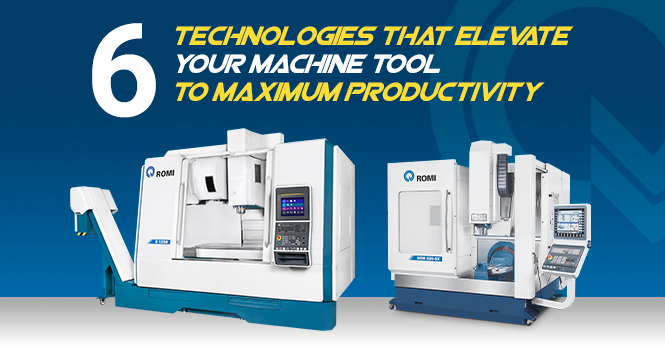
In recent decades, the emergence of new technologies has caused a real revolution in the development of machine tool projects. Machine tools were once limited to being a purely mechanical solutions for chip removal. The addition of digital controls and components with sophisticated and embedded technology, allowed them to today become a part of intelligent manufacturing cells, communicating with other peripherals, such as automatic parts loading and unloading systems, and becoming true operations centers.
From the design of a robust structure to the implementation of electronic components, there is much more than we imagine when it comes to designing and manufacturing machine tools capable of operating more efficiently, while maintaining their accuracy. Below are some of these technologies and components, and an explanation of how they influence the operation of a machining center, allowing for agile and efficient operation:
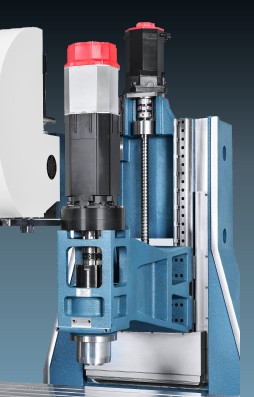
1. Spindle Direct Drive
Considered one of the most important components of a CNC Machining Center, the spindle is the interface between the tool, which removes the material, roughing or finishing parts, and the main motor of the machine.
Spindle Direct Drive – with the motor directly attached to the spindle, they have high acceleration rates, resulting in shorter cycle times. In addition, they have excellent running accuracy even at high speeds. The Spindle Direct Drive, which is featured on the Romi D Series – New Generation machining centers, provides excellent finishing, great transmission efficiency, torque, power, and rotation in versions up to 15,000 rpm.
2. CNC
Dating back to the 1960’s, computers were introduced into machine tool design, a fact that allowed the development of modern equipment. The advent of the CNC made the machines able to repeat with greater precision a sequence of movements, which increased the quality of products produced, reduced rework and waste, and made production lines faster and more flexible.
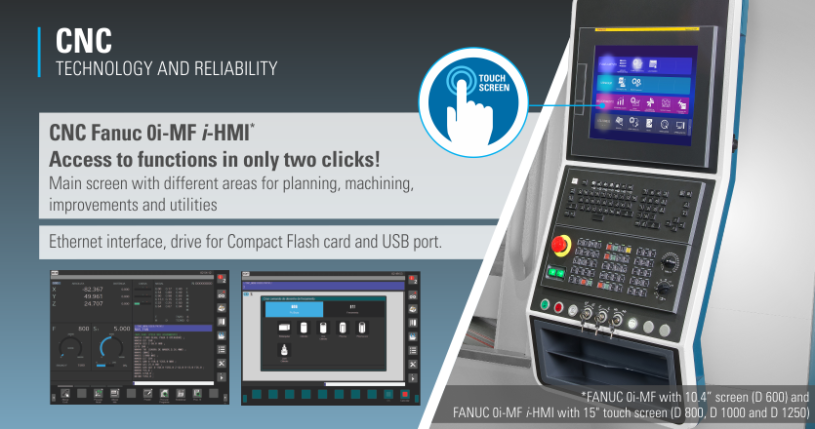
Thanks to the high capacity of processors and the evolution of code and machine language, today’s CNCs process programs much faster. Following advances in the field of information technology (IT), the need for connectivity and the trend towards increasing interactivity with the user, new features have also emerged to facilitate operation and provide an increasingly user-friendly operator-machine experience.
The Fanuc 0i-MF i-HMI CNC, used on the ROMI D800, ROMI D1000 and ROMI D1250 models with 15″ touchscreen monitors, offer the user great programming facilities. The main screen features different areas for planning, machining, improvements and utilities, an allows access to favorite functions in just two clicks. It has Ethernet interface; a Compact Flash card drive and USB port. Other features include:
- Environment that allows viewing various information on a single screen
- Tool manager with the possibility of inserting the drawings, facilitating their identification during setup
- Resources for corrective and preventive maintenance
- Machining programs that can be easily accessed and organized into folders, with visualization of the drawing of the parts
- Visualization of files in various formats
- Multiple interactive machining cycles
3. Linear Roller Guides
Linear guides are elements that allow one component to slide along another, allowing movement within a precise linear pattern, with vibration absorption and high feed rates. Fundamental elements in machine tools, they must be rigid enough not to affect the geometric or dimensional accuracy of the equipment.
Linear roller guides offer high rigidity and less deformation under repeated (varied) floating loads, as the rollers are positioned in a balanced shape, allowing them to receive loads in all directions. Other benefits include:
- Improvement in cutting capacity and better finishing performance
- Extended service life, and smooth, quiet movements
- Low consumption of lubricating oil
- Larger contact area compared to ball guides, obtaining greater load capacity
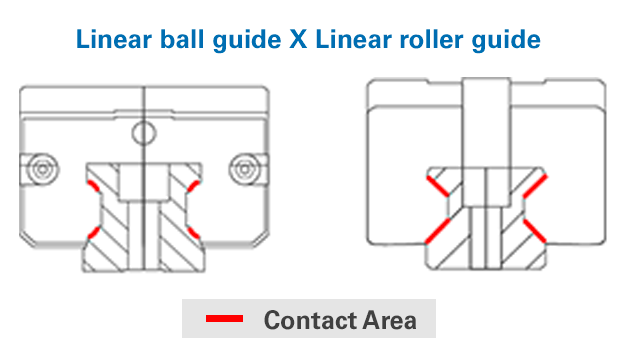
On the ROMI D Series – New Generation – and the ROMI DCM 620 Series, linear roller guides allow high advance and acceleration rates in addition to fast axis positioning. This minimizes passive times and increases productivity.
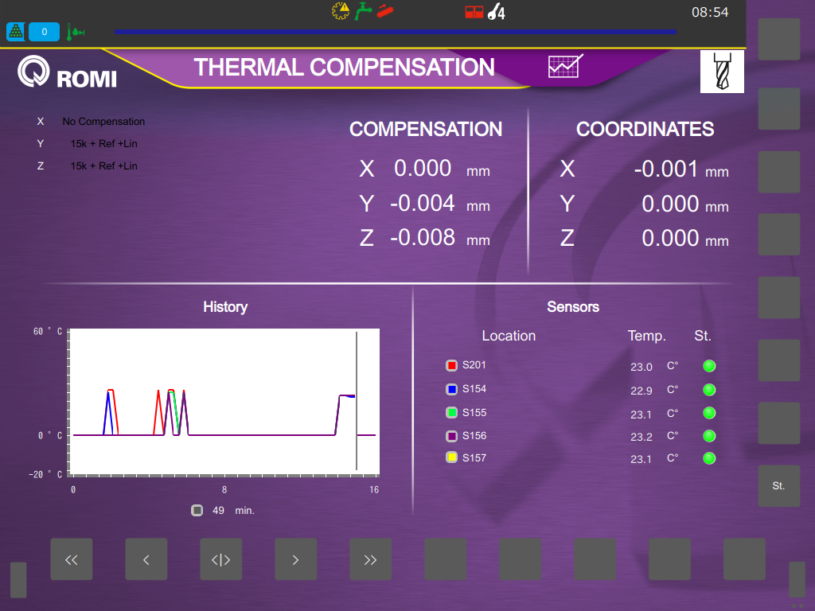
4. Thermal Compensation System
Thermal stability is one of the fundamental requirements in the design of a machine tool. Solutions to avoid deviations caused by thermal variations have become increasingly essential to obtain greater dimensional accuracy in machining processes.
In a Romi thermal compensation system, through the collection of temperature data from sensors positioned in strategic locations, the CNC corrects the actual position of each axis, allowing tool position to follow a more accurate trajectory, while allowing stable dimensional results even in long periods of work.
All ROMI D Series – New Generation and ROMI DCM 620 Series models have the thermal compensation system, developed to reduce the effects of temperature oscillation on the dimensionality of machined parts.
5. Correct component sizing
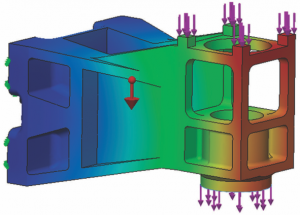
When we talk about the structure of a machine tool, we can highlight the main component: the base. All other components will be supported on the base and, therefore, it must be able to resist and dampen the effects of vibrations, temperature variations, loads, movements, and other factors. Another structural component is the column, which supported on the base, receives the head/spindle assembly.
Currently we have technologies that simulate real situations of use, allowing design adjustments prior to actual production of a machine tool. Through the use of finite element analysis, for example, it is possible to predict how the structure will behave due to its construction and the arrangement of its components. This makes it possible to evaluate the best configuration with regard to stiffness and deformations. It is important that the virtual modeling of the machine takes into account the actual characteristics such as material, contour conditions and movements, so that the analysis produces reliable results.
The correct dimensioning of each structural component is a determining factor in making a machine tool rigid, and robust. These characteristics allow higher chip start rates, such as those you will see in this ROMI D Series Machining Center video, which is machining at a cutting depth of 14mm.
6. Geometric and performance checks
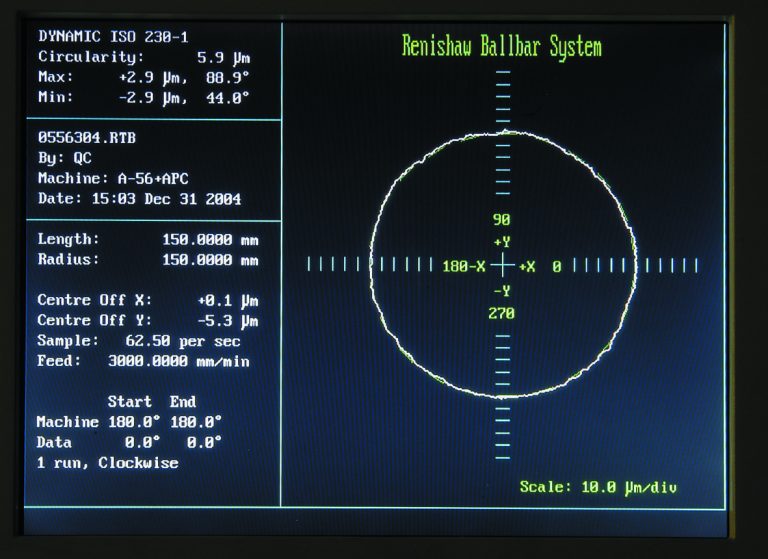
Before a machine tool is delivered to our customers, we perform checks and tests to assess the performance of the equipment and its suitability with established standards. One of the tests is the Ball Bar, which allows us to check the alignment of the axis and ensure a perfect interpolation of movement.
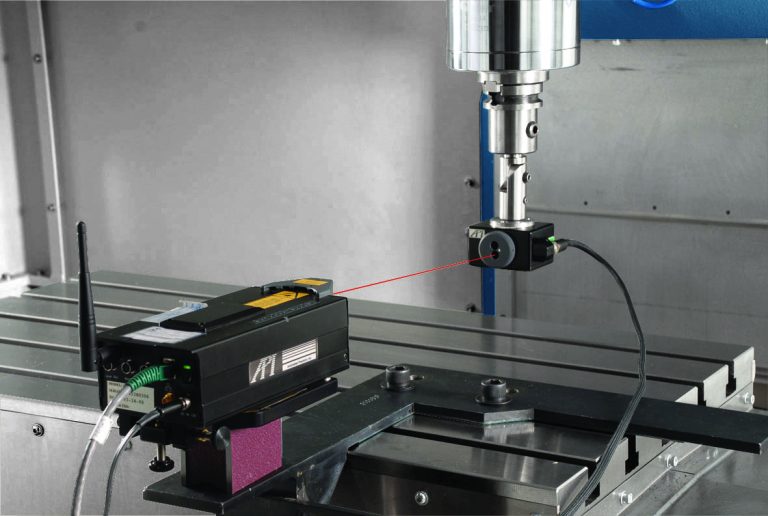
All machines are also inspected with a laser system for positioning and repeatability measurement.
In addition, we perform a 50-hour operating test, in which the equipment is subjected to routines that simulate its use in extreme situations, and allow us to access, for example, the tightness (if there are leaks), its behavior in the movement of the axis and rotations limits, as well as tool changes.
New Generation GL Series Turning CenterRomi has introduced the New Generation GL Series 2-Axis horizontal turning centers. The new machines are available in four models with maximum cutting diameters ranging from 11” (282 mm) to 19.3” (490 mm) and Z travel ranging from 23.6” (600 mm) to 47.2” (1,200 mm). Designed for medium to high production environments, the GL Series features notably high power, torque and feed force, in addition to Romi’s trademark rigidity and precision attributed to the robust “Romi-made” monoblock base.
Models include the GL250, GL300, GL350, and GL450. Each is constructed with durable roller ways on all axis to produce high rigidity. A built-in spindle motor with a chiller incorporated and direct drive servo-motors results in high response speed, accuracy, less vibration, and lower maintenance requirements. Chilling the motor increases life expectancy, and produces less thermal expansion.
The all new GL Series come standard with active thermal compensation to maintain consistent accuracy even as the machine temperature increases over the course of extended use. The tailstock is programmable and servo-driven. Position, speed, and force are determined directly via the Fanuc controller that reduces setup time.
Each model comes with a 12-station turret with a choice of fixed tools with a Romi disk, driven tools with a VDI or BMT disk, driven tools with Y-axis, or dual spindle with driven tools and Y-axis.
The CNC control features a Fanuc Oi-TF with 15” LCD touchscreen and Fanuc 32iB with 19” LCD touchscreen for dual spindle version machines and is the newest generation of Fanuc’s Series iHMI. It is designed to produce faster, more accurate performance for turning applications with separate areas on the main screen for planning, machining, improvements, and utilities. Functions are accessible with just two clicks. It comes standard with an ethernet interface, as well as a compact flash card and USB ports
Romi’s GL Series turning centers are all produced in Romi’s state-of-the-art facilities that maintain various safety and quality certifications including ISO 9001, ISO 14001, IATF 16949, and CE.
Source: Cutting Tool Engineering
Full-Power Horizontal Turning CentersThe GL Series two-axis machines are available in four models, for medium-to-high production programs, feature notably high power, torque, and feed force, in addition to rigidity and precision thanks to a monoblock base.
ROMI MACHINE TOOLS LTD.’s new-generation GL Series two-axis horizontal turning centers are available in four models with maximum cutting diameters ranging from 11 (282) to 19.3 in. (490 mm) and Z travel ranging from 23.6 (600) to 47.2 in. (1,200 mm). Designed for medium to high production environments, the GL Series features high power, torque, and feed force, along with rigidity and precision attributed to the monoblock base.
Models include the GL250, GL300, GL350, and GL450. Each is constructed with durable roller ways on all axis to produce high rigidity. A built-in spindle motor with a chiller incorporated and direct drive servo-motors results in high response speed, accuracy, less vibration, and lower maintenance requirements. Chilling the motor increases life expectancy, and produces less thermal expansion.
The GL Series come standard with active thermal compensation to maintain consistent accuracy even as the machine temperature increases over the course of extended use. The tailstock is programmable and servo-driven. Position, speed, and force are determined directly via the Fanuc controller that reduces setup time. Each model comes with a 12-station turret with a choice of fixed tools with a Romi disk, driven tools with a VDI or BMT disk, driven tools with Y-axis, or dual spindle with driven tools and Y-axis.
The CNC control features a Fanuc Oi-TF with 15-in. LCD touchscreen and Fanuc 32iB with 19-in. LCD touchscreen for dual spindle version machines and is the newest generation of Fanuc’s Series iHMI. It is designed to produce faster, more accurate performance for turning applications with separate areas on the main screen for planning, machining, improvements, and utilities. Functions are accessible with just two clicks. It comes standard with an ethernet interface, as well as a compact flash card and USB ports. Learn more at www.romiusa.com
Romi Machine Tools’ 2-axis horizontal turning centerRomi has introduced the new Generation GL series 2-axis horizontal turning centers. The new machines are available in four models with maximum cutting diameters ranging from 11″ (282mm) to 19.3″ (490mm) and Z travel ranging from 23.6″ (600mm) to 47.2″ (1,200mm). Designed for medium to high production environments, the GL Series features notably high power, torque, and feed force, in addition to Romi’s trademark rigidity and precision attributed to the robust Romi-made monoblock base.
Models include the GL250, GL300, GL350, and GL450. Each is constructed with durable roller ways on all axis to produce high rigidity. A built-in spindle motor with a chiller incorporated and direct-drive servomotors results in high response speed, accuracy, less vibration, and lower maintenance requirements. Chilling the motor increases life expectancy and produces less thermal expansion.
The all new GL Series come standard with active thermal compensation to maintain consistent accuracy even as the machine temperature increases over the course of extended use. The tailstock is programmable and servo driven. Position, speed, and force are determined directly via the Fanuc controller that reduces setup time.
Each model comes with a 12-station turret with a choice of fixed tools with a Romi disk, driven tools with a VDI or BMT disk, driven tools with Y-axis, or dual spindle with driven tools and Y-axis.
The CNC control features a Fanuc Oi-TF with 15″ LCD touchscreen and Fanuc 32iB with 19″ LCD touchscreen for dual spindle version machines and is the newest generation of Fanuc’s Series iHMI. It is designed to produce faster, more accurate performance for turning applications with separate areas on the main screen for planning, machining, improvements, and utilities. Functions are accessible with just two clicks. It comes standard with an ethernet interface, as well as a compact flash card and USB ports.
Romi’s GL Series turning centers are all produced in Romi’s state-of-the-art facilities that maintain various safety and quality certifications including ISO 9001, ISO 14001, IATF 16949, and CE.
More details on Romi’s new line of GL Series turning centers can be found on Romi’s newly designed website.
Source: Today’s Medical Developments
2-axis horizontal turning centerErlanger, Kentucky– Romi has introduced the New Generation GL Series 2-Axis horizontal turning centers. The new machines are available in four models with maximum cutting diameters ranging from 11″ (282mm) to 19.3″ (490mm) and Z travel ranging from 23.6″ (600mm) to 47.2″ (1,200mm). Designed for medium to high production environments, the GL Series features notably high power, torque, and feed force, in addition to Romi’s trademark rigidity and precision attributed to the robust Romi-made monoblock base.
Models include the GL250, GL300, GL350, and GL450. Each is constructed with durable roller ways on all axis to produce high rigidity. A built-in spindle motor with a chiller incorporated and direct-drive servomotors results in high response speed, accuracy, less vibration, and lower maintenance requirements. Chilling the motor increases life expectancy and produces less thermal expansion.
The all new GL Series come standard with active thermal compensation to maintain consistent accuracy even as the machine temperature increases over the course of extended use. The tailstock is programmable and servo driven. Position, speed, and force are determined directly via the Fanuc controller that reduces setup time.
Each model comes with a 12-station turret with a choice of fixed tools with a Romi disk, driven tools with a VDI or BMT disk, driven tools with Y-axis, or dual spindle with driven tools and Y-axis.
The CNC control features a Fanuc Oi-TF with 15″ LCD touchscreen and Fanuc 32iB with 19″ LCD touchscreen for dual spindle version machines and is the newest generation of Fanuc’s Series iHMI. It is designed to produce faster, more accurate performance for turning applications with separate areas on the main screen for planning, machining, improvements, and utilities. Functions are accessible with just two clicks. It comes standard with an ethernet interface, as well as a compact flash card and USB ports.
Romi’s GL Series turning centers are all produced in Romi’s state-of-the-art facilities that maintain various safety and quality certifications including ISO 9001, ISO 14001, IATF 16949, and CE.
More details on Romi’s new line of GL Series turning centers can be found on Romi’s newly designed website.