
The new machines are available in four models with maximum cutting diameters.
Romi has introduced the New Generation GL Series Two-Axis horizontal turning centers. The new machines are available in four models with maximum cutting diameters ranging from 11” (282 mm) to 19.3” (490 mm) and Z travel ranging from 23.6” (600 mm) to 47.2” (1,200 mm). Designed for medium to high production environments, the GL Series features notably high power, torque and feed force, in addition to Romi’s trademark rigidity and precision attributed to the robust “Romi-made” monoblock base.

Models include the GL250, GL300, GL350, and GL450. Each is constructed with durable roller ways on all axis to produce high rigidity. A built-in spindle motor with a chiller incorporated and direct drive servo-motors results in high response speed, accuracy, less vibration, and lower maintenance requirements. Chilling the motor increases life expectancy, and produces less thermal expansion.
The all new GL Series come standard with active thermal compensation to maintain consistent accuracy even as the machine temperature increases over the course of extended use. The tailstock is programmable and servo-driven. Position, speed, and force are determined directly via the Fanuc controller that reduces setup time.
Each model comes with a 12-station turret with a choice of fixed tools with a Romi disk, driven tools with a VDI or BMT disk, driven tools with Y-axis, or dual spindle with driven tools and Y-axis.
The CNC control features a Fanuc Oi-TF with 15” LCD touchscreen and Fanuc 32iB with 19” LCD touchscreen for dual spindle version machines and is the newest generation of Fanuc’s Series iHMI. It is designed to produce faster, more accurate performance for turning applications with separate areas on the main screen for planning, machining, improvements, and utilities. Functions are accessible with just two clicks. It comes standard with an ethernet interface, as well as a compact flash card and USB ports
Romi’s GL Series turning centers are all produced in Romi’s state-of-the-art facilities that maintain various safety and quality certifications including ISO 9001, ISO 14001, IATF 16949, and CE.
For more information: Romi’s website.
Romi Announces New Generation GL Series Turning CenterThe GL Series features high power, torque and feed force, in addition to Romi’s trademark rigidity and precision attributed to the robust monoblock base.
ERLANGER, KENTUCKY, UNITED STATES, October 7, 2020 /EINPresswire.com/ — Romi has introduced the New Generation GL Series 2-Axis horizontal turning centers. The new machines are available in four models with maximum cutting diameters ranging from 11” (282 mm) to 19.3” (490 mm) and Z travel ranging from 23.6” (600 mm) to 47.2” (1,200 mm). Designed for medium to high production environments, the GL Series features notably high power, torque and feed force, in addition to Romi’s trademark rigidity and precision attributed to the robust “Romi-made” monoblock base.
Models include the GL250, GL300, GL350, and GL450. Each is constructed with durable roller ways on all axis to produce high rigidity. A built-in spindle motor with a chiller incorporated and direct drive servo-motors result in high response speed, accuracy, less vibration, and lower maintenance requirements. Chilling the motor increases life expectancy, and produces less thermal expansion.
The all-new GL Series comes standard with active thermal compensation to maintain consistent accuracy even as the machine temperature increases over the course of extended use. The tailstock is programmable and servo-driven. Position, speed, and force are determined directly via the Fanuc controller that reduces setup time.
Each model comes with a 12-station turret with a choice of fixed tools with a Romi disk, driven tools with a VDI or BMT disk, driven tools with Y-axis, or dual spindle with driven tools and Y-axis.
The all-new GL Series comes standard with active thermal compensation to maintain consistent accuracy even as the machine temperature increases over the course of extended use.”
Mr. Rafael Boldorini
The CNC control features a Fanuc Oi-TF with 15” LCD touchscreen and Fanuc 32iB with 19” LCD touchscreen for dual spindle version machines and is the newest generation of Fanuc’s Series iHMI. It is designed to produce faster, more accurate performance for turning applications with separate areas on the main screen for planning, machining, improvements, and utilities. Functions are accessible with just two clicks. It comes standard with an ethernet interface, as well as a compact flash card and USB ports
Romi’s GL Series turning centers are all produced in Romi’s state-of-the-art facilities that maintain various safety and quality certifications including ISO 9001, ISO 14001, IATF 16949, and CE.
More details on Romi’s new line of GL Series turning centers can be found on Romi’s newly designed website.
About Romi Machine Tools Ltd
Romi Machine Tools Ltd is based in Erlanger, KY, and is a wholly-owned subsidiary of Brazilian based ROMI S.A. Serving the USA and Canada, Romi Machine Tools Ltd offers customers a line of innovative and robust machine tools including CNC lathes, turning centers, and vertical machining centers. All the key parts used to build a Romi machine tool, including the base castings, are made at the company’s state-of-the-art manufacturing facility in Santa Barbara d’Oeste, Brazil. This control over all key components allows Romi to build a particularly rigid, accurate and high-performance solution.
Romi Machine Tools Ltd, also known as Romi USA, maintains a showroom and full parts and service department at its Erlanger location. Its machine tools are available through a network of direct sales personnel and regional distributors. For more information on Romi’s products and solutions, visit www.romiusa.com.
Source: EIN Automotive Industry Today
CNC Teach Lathes Operate Manually or Automatically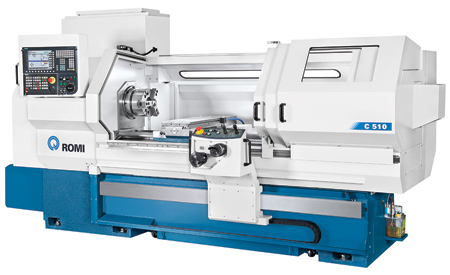
Romi’s C Series CNC teach lathes includes six models ranging from the C 420 with a 17″ (430 mm) swing over bed, a 4,000 RPM 12.5 HP main motor and 39″ between centers, to the C 1000 with a 40″ (1,000 mm) swing over bed, a 500 RPM 45 HP main motor and up to 197″ between centers.
Each Romi C Series lathe is equipped with the Romi Manual Machining Package (RMMP) that allows simple operations to be completed without any type of programming. According to the company, it is as simple to use as a manual lathe but with the added capability and productivity of a CNC Lathe.
Using the RMMP, an operator can machine parts in manual mode using the handwheels, and also in automatic mode using a joystick and start cycle. The operator can also fill in the fields on the CNC screen, indicating spindle speed, feeds, cutting depth, coordinates and angles, and start the machining with the cycle start button.
“All key components of Romi C Series lathes, including the Monobloc bed, are designed and built in-house for complete control and assurance of manufacturing quality,” said a company spokesperson. “The beds feature a robust structure supported by cast iron columns and are internally ribbed to absorb vibrations during machining. Flat and prismatic guides are hardened and ground to ensure high wear resistance and are self-adjusting to provide permanent contact of the cross slide over the bed. These features result in high rigidity, stability and precision in machining operations at full power.”
All C Series models are equipped with a Siemens Sinumerik 828D CNC that features a 10.4″ LCD color monitor and offers enhanced conversational programming, operation and machining simulation resources.
Industry Evolution: Understanding the Impact of Industry 4.0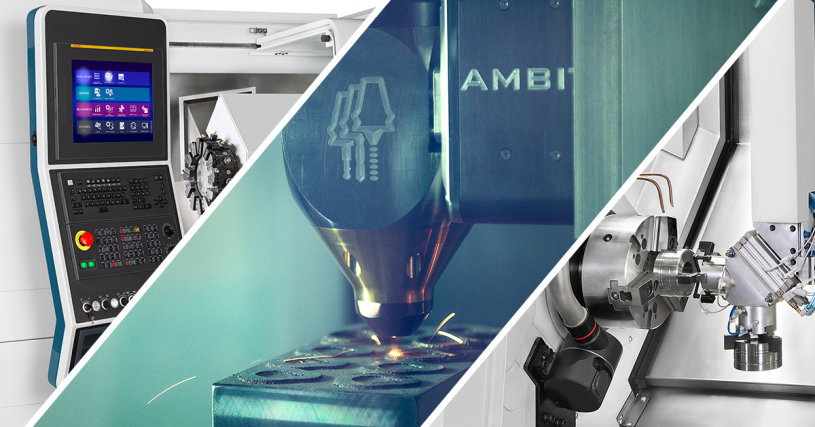
It goes without saying that industry is constantly changing. At the beginning of the 17th century, the industrial revolution arose with mechanization and steam machines. Almost 100 years later, we went through the era of scale production, electricity, and combustion, and then automation, the internet, robotics, and computers in the 20th century. Nowadays, the industry is experiencing a new revolution known as Industry 4.0 or advanced manufacturing: the era of digitization and the Industrial Internet of Things (IIoT).
As Industry 4.0 becomes more commonplace, computers connect and communicate with each other to make decisions with the least possible human involvement. A combination of systems, IIoT and artificial intelligence make Industry 4.0 possible, and the smart factory is a reality.
As a result, machines become increasingly intelligent, efficient, productive, and less wasteful as they have greater capacity to interpret information generated by systems and automatically act to reduce failures.
Industry 4.0 Impact
The impacts of Industry 4.0 are already visible in all sectors. Many companies are looking ahead and preparing for this next step in the evolution. Learn about some of these technologies and how they can positively contribute to your business:
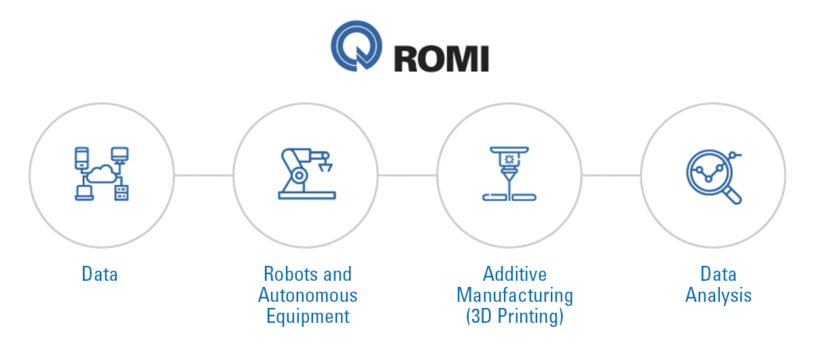
Data
Connected machines collect huge volumes of data that can contain information about maintenance, performance, and other important information, in addition to analyzing this data to identify patterns and insights that would be impossible for a human being. In this way, Industry 4.0 offers the opportunity for manufacturers to improve their operations quickly and efficiently and knowing exactly what needs more attention.
Robots and Autonomous Equipment
Robotics is increasingly accessible and available to companies of all sizes, ensuring greater autonomy for machines.
An example is Romi’s Gantry Loader, an automatic parts, loading and unloading system with an 8-station magazine and a rapid advance of 60 m/min, which provides high productivity gains and make it possible to reduce up to 80% loading and unloading time.
The system has a mechanical arm, which places the part on the plate and, after the finished process, removes the part, repeating this process continuously, thus avoiding the need to stop the process to perform to perform the part exchange and the operator’s intervention on the machine.
Additive manufacturing (3D printing)
This technology has developed significantly over the past decade and its advances allow many production possibilities.
The ROMI D Hybrid Line combines high-precision machining with additive manufacturing (3D metallic printing). It allows greater ease in the manufacture of parts with complex profiles, through the addition of ferrous materials and special alloy steels, such as Inconel and Stainless Steels, and generates savings in the use of high cost materials. The solidification process via solid state laser, as known as Direct Energy Deposition (DED) also allows the strategic addition of higher strength materials in areas of increased wear of the machined part, and allows molds to be repaired in damaged areas more easily and quickly, in addition to perform recording operation.
Data analysis
Data collection and analysis are key components of Industry 4.0. As the data is stored in the cloud, equipment and operations can be optimized through data analysis, such as with the ROMI D – New Generation Series and ROMI GL – New Generation – Series, equipped with CNC Fanuc controls. The New Generation machines allow the collection, management, and analysis of data, quickly identifying production failures and minimizing operating errors. The system also allows connectivity with other equipment, transmitting data between them and providing greater productive control.
The current state of industrial evolution requires adaptations in the traditional production relationship between suppliers, producers, and customers, as well as the interaction between the human and the machine. This change improves industry efficiency, but it can become a challenge if it is not performed correctly. Searching for the right technologies for your company, training employees for new equipment and being prepared for new market demand are fundamental steps for success in an Industry 4.0 world.
With our help, your company can also be part of the New Generation Industry. Contact us for more information on the most modern and robust machine tools on the market.
Heavy Duty CNC Lathes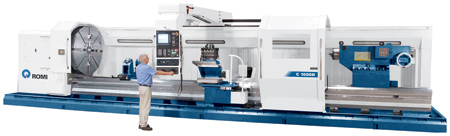
Romi C Series heavy-duty flatbed CNC lathes are built with Romi made monoblock cast iron beds for increased rigidity, accuracy and performance. The heavy-duty C Series includes nine models ranging from the C 1100H with a 28″ (720 mm) swing over cross slide and 72 HP main motor, to the large C 2600H with an 80″ (2,030 mm) swing over cross slide and a 155 HP main motor. All key components of Romi machine tools are designed and built in house for complete control and assurance of manufacturing quality.
Romi’s line of heavy-duty CNC lathes feature net weights ranging from approximately 39,700 lbs. (18,000 kg) to 134,500 lbs. (61,000 kg), maximum weight between centers from 33,100 lbs. (15,000 kg) to 110,200 lbs. (50,000 kg) and maximum torque from 12,429 Nm to 44,200 Nm.
The monoblock bed is made of gray cast iron and offers enhanced rigidity. The cast iron headstock, also manufactured by Romi, features a spindle with Timken bearings.
Romi heavy-duty CNC lathes are powered by a high torque, continuously variable speed AC motor. The manually driven quill has a built-in live center with high precision bearings.
All models are built to reduce machine vibration and allow fast and accurate machining at full power. They are suitable for heavy applications in the mining, aerospace, steel mill, and oil and gas industries.
Romi’s D series gets makeoverYou may have seen machine tools with the same names before. But you’ve never seen anything like the new generation D series vertical machining centers from Romi Machine Tools Ltd. in Erlanger, Kentucky, said Regional Sales Manager Steve Reeves.
He said although the latest D series machines kept the names of their predecessors, “they are brand-new machines from top to bottom.”
In the U.S., Romi Machine Tools sells three D series models: the 6,577 kg (14,500 lbs.) D 800, which offers 787 mm (31″) of x-axis travel; the 6,895 kg (15,200 lbs.) D 1000, which offers 1,016 mm (40″) of x-axis travel; and the 6,985 kg (15,400 lbs.) D 1250, which offers 1,270 mm (50″) of x-axis travel. Maximum travel for all three models is 610 mm (24″) along the y-axis and 635 mm (25″) on the z-axis.

The D series VMCs have been redesigned completely for improved performance. Image courtesy of Romi Machine Tools
In most cases, Reeves said, the fact that the D 800 provides as much y- and z-axis travel as its larger counterparts is an advantage because customers usually want more travel distance along those axes. On the other hand, this also makes the D 800 a larger machine.
“If you need to get a machine into a very tight space,” he said, the D 800 “may not physically fit while some of our competitors’ smaller machines will.”
Like all Romi machine tools, D series machines feature Romi-made cast-iron beds that absorb vibration. In addition, all the machines are equipped with big-bore, 40-taper, direct-drive spindles. The company points out that direct-drive technology offers low maintenance and improved accuracy and repeatability, plus the big-bore 40-taper boosts stiffness and allows increased depth of cut during machining.
Compared with the previous D series versions, the new machines show cutting depth increases of up to 133% before vibration occurs, according to testing by Romi. In machining operations, Reeves said, the result is fewer passes and shorter cycle times.
D series spindles operate at speeds of 10,000 or 15,000 rpm, which he said is too low for minting and other applications that require very high spindle speeds. He noted, however, that the addition of a speeder head could boost the speed of D series spindles to 60,000 rpm.
Reeves said the new machines are the first in North America equipped with the Fanuc 0i-MF iHMI CNC, which includes a 381 mm (15″) touch screen and a high-speed, high-quality package. The latter, he said, presents a variety of machining speed and surface finish options in a grid-style arrangement of boxes on the screen for operators. This makes it easy to determine the proper trade-off between cycle time and surface finish for a particular application.
“The vertical column is speed,” he explained, “and the horizontal column is surface finish. As you (increase) speed, generally you will sacrifice surface finish. So this allows users to exactly choose their priorities. For example, you don’t need the utmost accuracy when roughing, so you can (opt for more) speed for roughing cycles.”
Other key features of the new machines include sensor-based thermal compensation, linear roller guides that facilitate feed rates up to 40 m (1,575″) per minute and a 30-tool automatic vertical toolchanger.
Still, Reeves said the machines aren’t unique in the sense that they provide many things that competitor machines lack.
Instead, “we’re unique because we offer extremely well-equipped machines at a much better price,” he said, adding that shops might have to spend 50% more to get other machines with the same features as these new offerings.
Reeves said part of the dramatic price difference stems from Romi Machine Tools owning a 139,355 m² (1.5 million sq. ft.) facility in Brazil, where the company pours its own castings and does a lot of other manufacturing work that competitors outsource.
“They buy components and assemble machines,” he said. “We actually build machines.”
Source: Cutting Tool Engineering
Heavy-Duty CNC Lathes Feature Monoblock Cast Iron BedsNine C Series flatbed CNC lathes from Romi Machine Tools are designed for heavy applications in the mining, aerospace, steel mill, and oil-and-gas industries. All key components are manufactured in-house to ensure quality.
The monoblock bed of Romi Machine Tools’ C Series lathe is made of cast iron for extreme rigidity. Nine models range in size from the C 1100H with a 28-inch (720 mm) swing over cross slide and 72-hp main motor to the massive C 2600H with an 80-inch (2,030 mm) swing over cross slide and 155-hp main motor.
C Series heavy-duty flatbed CNC lathes from Romi Machine Tools Ltd. (Erlanger, KY) are built on cast iron monoblock beds to optimize rigidity, accuracy, and performance. To ensure quality, key components including the machine bed are designed and built in-house at the company’s facility in Brazil.
Nine models range in size from the C 1100H with a 28-inch (720 mm) swing over cross slide and 72-hp main motor to the massive C 2600H with an 80-inch (2,030 mm) swing over cross slide and a 155-hp main motor.
Net weights range from approximately 39,700 pounds (18,000 kg) to 134,500 pounds (61,000 kg), maximum weight between centers range from 33,100 pounds (15,000 kg) to 110,200 pounds (50,000 kg), and maximum torque ranges from 12,429 Nm to 44,200 Nm.
The cast iron headstock features a spindle with Timken bearings. The lathes are powered by a high-torque, continuously variable-speed AC motor. The manually driven quill has a built-in live center with high-precision bearings.
All models are built to reduce machine vibration and allow fast and accurate machining at full power. They’re ideal for heavy applications in the mining, aerospace, steel mill, and oil and gas industries.
Source: Fabricating and Metalworking
Generation D Series Vertical Machining Centers
Designed and built based on extensive customer research, the New Generation Romi D Series vertical machining centers offer users higher productivity, robustness, and precision. Like all Romi machine tools, they are built with Romi made monoblock cast iron beds that absorb vibration and allow consistent production of highly precise parts.
In the USA, Romi offers three models, the D 800, the D 1000, and the D 1250. All three are equipped with big-bore 40-taper direct drive spindles with speeds of 10,000 or 15,000 rpm. Direct drive is low maintenance and improves accuracy and repeatability, while the big-bore 40-taper increases stiffness and allows increased depth of cut during machining.
The machines are equipped with thermal compensation, with sensors, to improve precision. Each model is equipped with a Fanuc 0i-MF i-HMI CNC with 15” touchscreen, and a high speed and high quality package that allows better performance during machining.
Linear roller guides on all three models facilitate feed rates up to 1,575 inches / minute (40 m / min), which allows for precise and fast acceleration and positioning. They also increase robustness during machining and load capacity (part weight) on the table.
The three models, D 800, D 1000 and D 1250 have a robust net machine weight of 20,500 lbs, 21,800 lbs and 23,000 lbs respectively, and a maximum machining volume of 31 x 24 x 25 inches, 40 x 24 x 25 inches and 50 x 24 x 25 inches respectively. Each model is equipped with a a 30 tool automatic vertical tool changer.
CNC teach lathes
